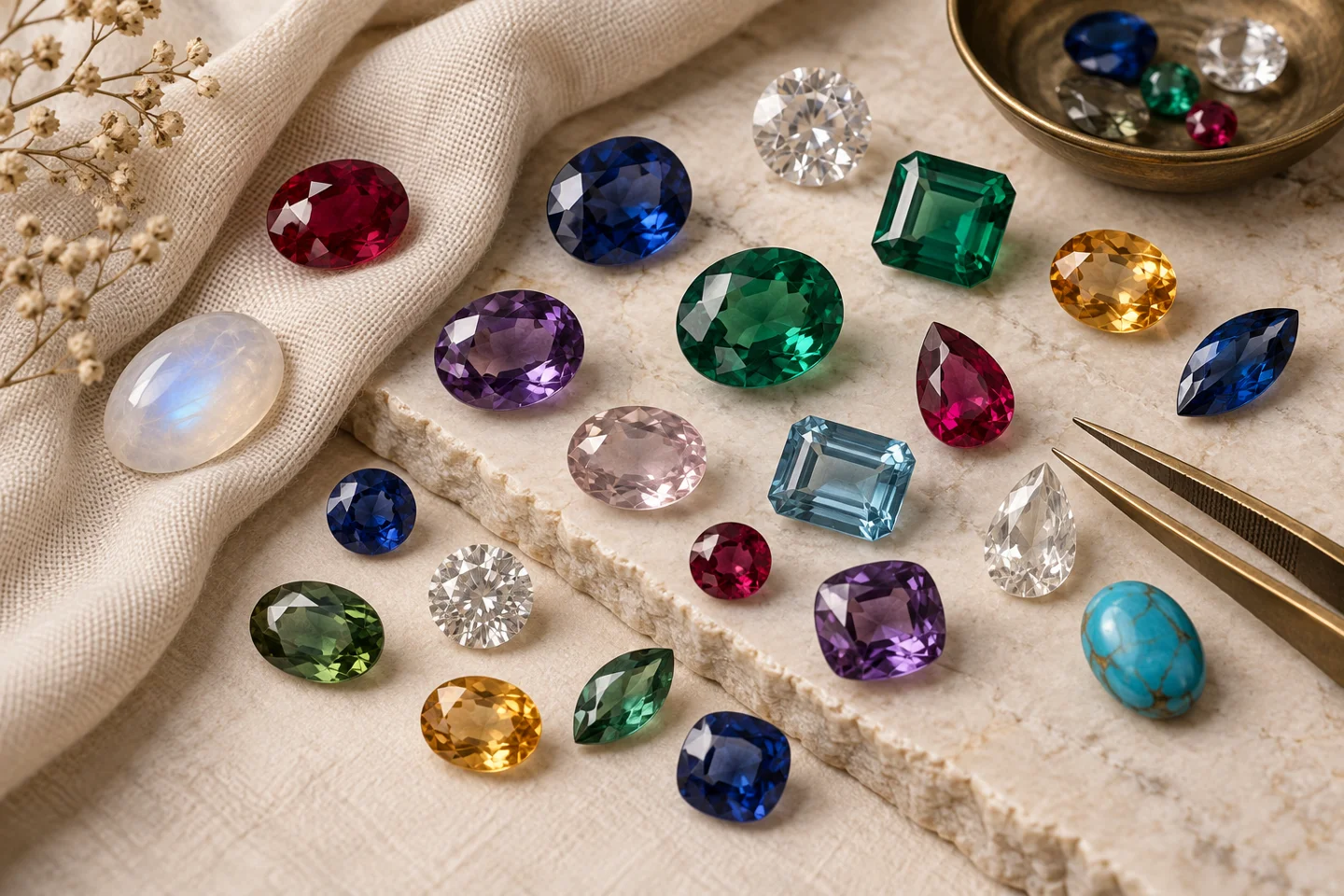
A stone specification needs four separate facts: its material, its outline, its cutting style, and its measured dimensions. This gemstone guide brings those facts together for jewelry design, stone selection, replacement, and workshop planning.
Gemstone types and material information
A color or trade name alone cannot identify a stone. The following short descriptions introduce common gem materials. A name in this directory does not confirm that a particular loose stone is natural, untreated, or suitable for daily wear.
| Stone | Material or identifying feature |
|---|---|
| Diamond | Carbon gem; colorless and fancy colors. |
| Ruby | Red corundum. |
| Sapphire | Corundum in blue and other colors. |
| Emerald | Green beryl. |
| Aquamarine | Blue to green-blue beryl. |
| Morganite | Pink to peach beryl. |
| Alexandrite | Chrysoberyl known for color change. |
| Amethyst | Purple quartz. |
| Ametrine | Quartz with amethyst and citrine colors. |
| Citrine | Yellow to orange quartz. |
| Rose quartz | Pink quartz. |
| Garnet | Mineral group with many colors. |
| Iolite | Blue-violet gem. |
| Jade | Jadeite and nephrite materials. |
| Kunzite | Pink to violet spodumene. |
| Lapis lazuli | Blue ornamental rock. |
| Moonstone | Feldspar showing a soft light effect. |
| Opal | Some varieties show play-of-color. |
| Pearl | Organic gem; natural or cultured. |
| Peridot | Yellow-green to green olivine. |
| Spinel | Available in many colors. |
| Sunstone | Feldspar; some stones show glittering inclusions. |
| Tanzanite | Blue-violet zoisite. |
| Topaz | Available in several colors. |
| Tourmaline | Colorful mineral group, including multicolor gems. |
| Turquoise | Blue to green, commonly opaque. |
| Zircon | Natural gem; different from cubic zirconia. |
Reference: GIA Gem Encyclopedia. Open the material’s profile for its properties, treatments, and buyer guidance.
Garnet varieties
Almandine, pyrope, spessartine, grossular, andradite, rhodolite, tsavorite, demantoid, hessonite, and color-change garnet belong in a broader garnet reference. Some names identify species; others identify varieties or mixtures. GIA lists a typical garnet hardness range of 6.5–7.5 and a specific-gravity range of 3.47–4.15. Do not use one fixed density for every garnet.
Garnet properties and varietiesSapphire colors and effects
Sapphire includes blue, pink, yellow, green, violet, orange, colorless, and other colors. Padparadscha describes a pink-orange color range; star sapphire and color-change sapphire describe optical effects. Red corundum is ruby. Color labels are not separate mineral species and do not prove origin or treatment status.
Sapphire referenceTourmaline, topaz, jade, and pearl
Tourmaline references include rubellite, Paraíba, and multicolor material. Jade terminology requires distinguishing jadeite from nephrite. Pearl records should specify natural or cultured and the pearl type, rather than calling every white round bead a pearl. Topaz colors and treatment status should be recorded separately.
Tourmaline · Topaz · Jade · Pearl
Expanded mineral and collector-material directory
This extended index includes jewelry materials and rare collector gems. Inclusion does not mean a material is suitable for setting, wearing, cutting, or cleaning in the same way as diamond or sapphire. Consult the individual material profile before handling or working it.
- Actinolite
- Adamite
- Agate
- Albite
- Algodonite
- Almandine garnet
- Amazonite
- Amblygonite
- Ammolite
- Analcime
- Anatase
- Andalusite
- Andesine
- Andradite
- Anglesite
- Anhydrite (angelite)
- Anorthite
- Apatite
- Apophyllite
- Aragonite
- Augelite
- Axinite
- Azurite
- Barite
- Bayldonite
- Benitoite
- Beryllonite
- Bismutotantalite
- Bloodstone
- Boleite
- Boracite
- Bornite
- Brazilianite
- Breithauptite
- Brookite
- Brucite
- Bustamite
- Bytownite
- Calcite
- Canasite
- Cancrinite
- Carnelian
- Cassiterite
- Catapleiite
- Celestite
- Ceruleite
- Cerussite
- Chabazite
- Chalcedony
- Chambersite
- Charoite
- Chicken-blood stone
- Childrenite
- Chiolite
- Chromite
- Chrysoberyl
- Chrysocolla
- Chrysoprase
- Cinnabar
- Clinochlore
- Cobaltite
- Colemanite
- Corundum
- Covellite
- Creedite
- Crocoite
- Cryolite
- Cuprite
- Danburite
- Datolite
- Demantoid garnet
- Diaspore
- Dickinsonite
- Diopside
- Dioptase
- Dolomite
- Dumortierite
- Ekanite
- Enstatite
- Eosphorite
- Epidote
- Euclase
- Eudialyte
- Feldspar
- Fluorite
- Grandidierite
- Grossular garnet
- Hambergite
- Haüyne
- Heliodor
- Hematite
- Hemimorphite
- Herderite
- Hessonite
- Howlite
- Hydrogrossular garnet
- Jadeite
- Jasper
- Jet
- Kyanite
- Labradorite
- Lapis lazuli
- Larimar
- Malachite
- Nephrite
- Obsidian
- Onyx
- Orthoclase
- Painite
- Petalite
- Phenakite
- Phosphophyllite
- Prehnite
- Pyrite
- Pyrope garnet
- Quartz
- Red beryl
- Rhodochrosite
- Rhodolite garnet
- Rhodonite
- Rubellite
- Rutile
- Scapolite
- Scheelite
- Serpentine
- Sillimanite
- Sinhalite
- Smithsonite
- Sodalite
- Sphalerite
- Sphene (titanite)
- Spodumene
- Staurolite
- Stichtite
- Sugilite
- Sulfur
- Taaffeite
- Tremolite
- Tsavorite garnet
- Tugtupite
- Uvarovite garnet
- Variscite
- Vesuvianite
- Willemite
- Witherite
- Zincite
- Zoisite
For individual profiles and further species, see the International Gem Society’s A–Z encyclopedia, which includes over 300 entries.
Lab-grown stones, simulants, and assembled materials
Record these separately: laboratory-grown diamond, synthetic ruby, synthetic sapphire, synthetic emerald, synthetic spinel, moissanite, cubic zirconia (CZ), and glass. A laboratory-grown counterpart is different from a simulant that only resembles another gem. Moissanite and CZ are not diamonds. Natural zircon is not CZ. Doublets, triplets, coatings, and fillings also need separate disclosure; an assembled stone cannot be described accurately by its visible top layer alone. GIA explains these distinctions.
Gemstone shapes and cuts
Shape is the outer outline. Cutting style describes the surface and facet arrangement. An oval stone can be faceted or polished as a cabochon; emerald cut is a cutting style and does not mean the material is emerald.
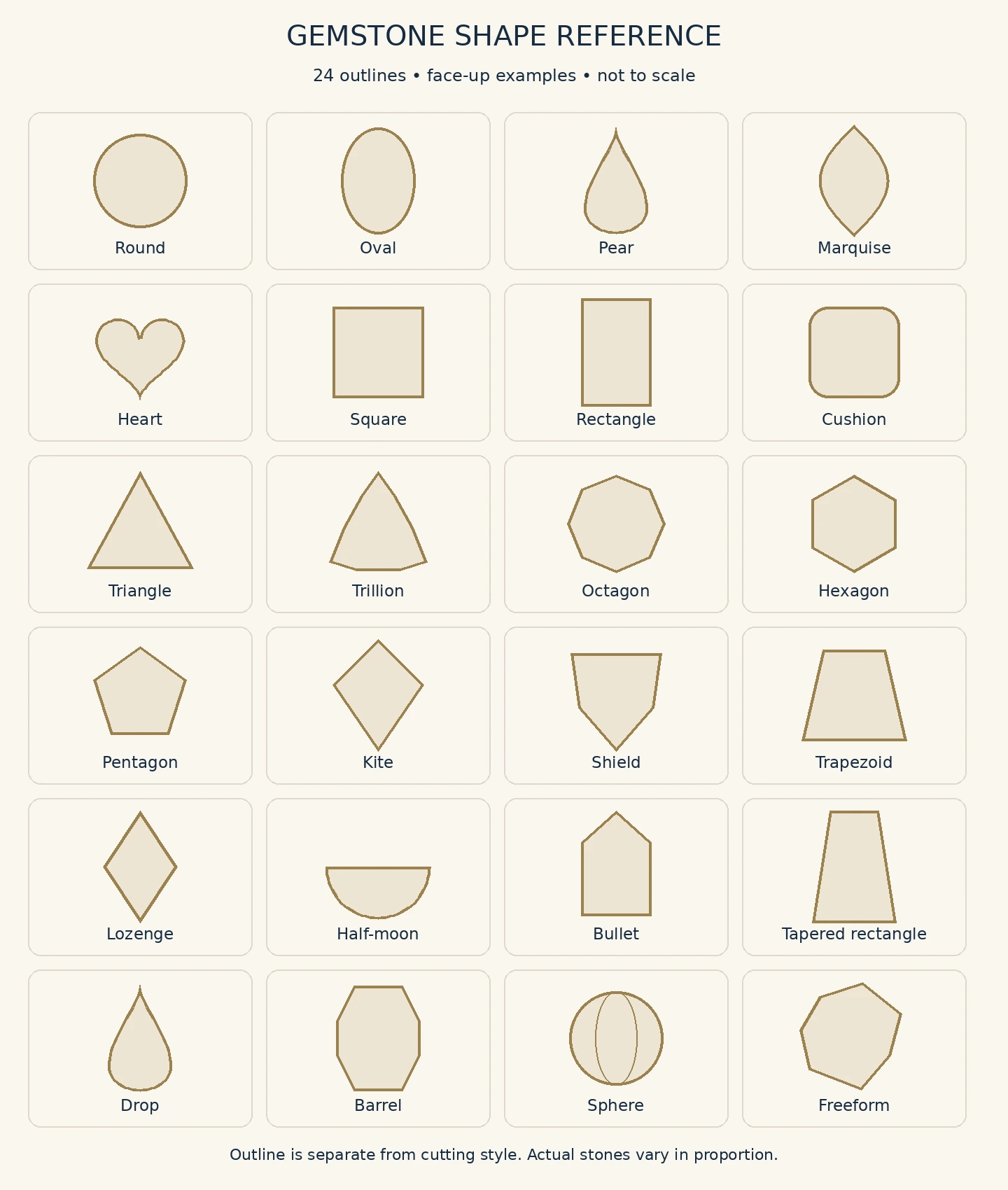
Small drawings in the cut table show representative outlines or polished forms. They are not exact facet plans; use the description and a cutter’s drawing to specify the cutting style.
| Cut or finish | Description |
|---|---|
| Round brilliant | Circular outline; brilliant facets. |
| Oval | Elongated round outline. |
| Pear / teardrop | Rounded end and pointed end. |
| Marquise / navette | Elongated outline with two points. |
| Heart | Heart outline with a cleft. |
| Cushion | Square or rectangle; rounded corners. |
| Princess | Square, usually brilliant-style facets. |
| Emerald cut | Clipped corners; step facets. |
| Asscher-style / square emerald | Square outline; step facets. |
| Radiant | Clipped corners; brilliant-style facets. |
| Baguette | Narrow rectangular step cut. |
| Tapered baguette | Step cut; unequal end widths. |
| Trillion / trilliant | Triangular outline; facet patterns vary. |
| Rose cut | Domed faceted crown; typically flat base. |
| Old European cut | Historic round diamond cut. |
| Old mine cut | Historic cushion-like diamond cut. |
| Briolette | Faceted drop, often for hanging jewelry. |
| Cabochon | Polished dome; no faceted crown. |
| Double cabochon | Domed on both sides. |
| Checkerboard | Pattern of crown facets. |
| Scissor / cross cut | Crossing facet pattern. |
| Barion / mixed cut | Combines facet arrangements. |
| Fantasy / concave cut | Carved or curved cutting features. |
| Portrait / tablet | Thin, flat appearance. |
| Bead | Drilled spherical or shaped material. |
| Carving / cameo / intaglio | Relief or engraved design. |
| Freeform / custom | Individual outline and proportions. |
Facet patterns vary between cutters and materials. Proprietary and artistic cuts can fall outside these names. Specify a drawing and actual measurements when a familiar label does not describe the stone accurately. Sources: GIA cutting definitions and GIA shape guide.
Stone sizes in millimeters, including custom dimensions
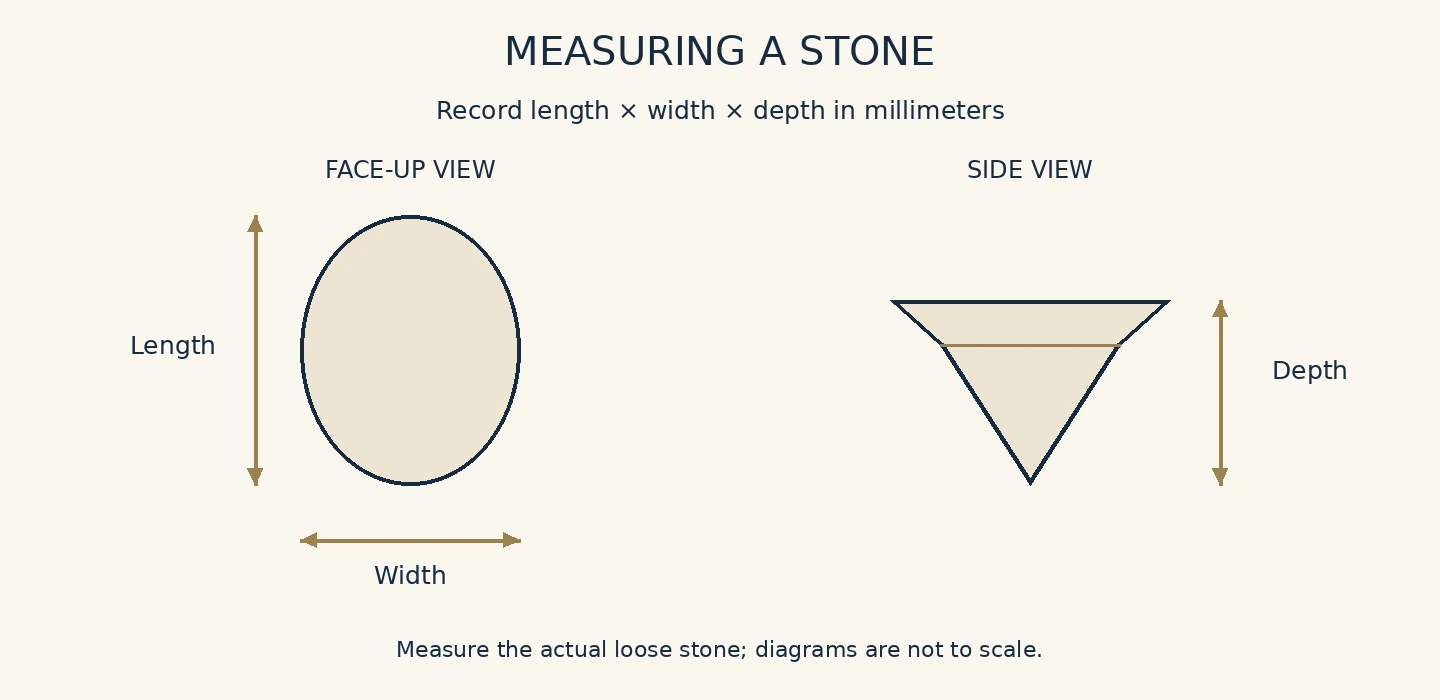
There is no universal table of every possible stone size. Calibrated stock sizes depend on the material, supplier, and cut; custom-cut stones are not limited to whole or half millimeters. A mounting must fit the actual stone, not a size inferred from its carat label.
| Stone form | Measurements to record |
|---|---|
| Round | Minimum diameter, maximum diameter, and total depth. |
| Oval, cushion, rectangle, emerald cut | Length × width × depth. |
| Pear, marquise, heart, kite, shield | Length × width × depth; include tip or cleft details. |
| Square, princess, Asscher-style | Length × width × depth; record clipped or sharp corners. |
| Triangle / trillion | Side measurements, overall height or width, and depth; include a drawing. |
| Tapered baguette / trapezoid | Length, both end widths, depth, and taper. |
| Cabochon | Length × width × height; note dome and base. |
| Briolette / drilled drop | Length, maximum width, hole diameter, and hole position. |
| Pearl / bead | Diameter or length × width; hole diameter for drilled pieces. |
| Freeform / carving / rough | Maximum dimensions plus a scale drawing or outline template. |
Illustrated stone size charts
Choose a shape below to see small stone illustrations beside example millimeter dimensions. Within these grids, the drawings use the same display scale, so larger dimensions produce larger pictures. These are dimension examples, not a supplier inventory or a universal calibrated-size standard. Facet lines are schematic; material, cut, depth and weight must be specified separately. Screen zoom changes their apparent size.
Round — 39 illustrated size examples
Diameter in millimeters. Actual depth and proportions vary.
Oval — 13 illustrated size examples
Length × width in millimeters. Actual depth and proportions vary.
Pear — 13 illustrated size examples
Length × width in millimeters. Actual depth and proportions vary.
Marquise — 13 illustrated size examples
Length × width in millimeters. Actual depth and proportions vary.
Heart — 13 illustrated size examples
Length × width in millimeters. Actual depth and proportions vary.
Square — 14 illustrated size examples
Overall face-up span (verify exact side and corner measurements) in millimeters. Actual depth and proportions vary.
Rectangle — 13 illustrated size examples
Length × width in millimeters. Actual depth and proportions vary.
Cushion — 13 illustrated size examples
Length × width in millimeters. Actual depth and proportions vary.
Triangle — 13 illustrated size examples
Length × width in millimeters. Actual depth and proportions vary.
Trillion — 13 illustrated size examples
Length × width in millimeters. Actual depth and proportions vary.
Octagon — 14 illustrated size examples
Overall face-up span (verify exact side and corner measurements) in millimeters. Actual depth and proportions vary.
Hexagon — 14 illustrated size examples
Overall face-up span (verify exact side and corner measurements) in millimeters. Actual depth and proportions vary.
Pentagon — 14 illustrated size examples
Overall face-up span (verify exact side and corner measurements) in millimeters. Actual depth and proportions vary.
Kite — 13 illustrated size examples
Length × width in millimeters. Actual depth and proportions vary.
Shield — 13 illustrated size examples
Length × width in millimeters. Actual depth and proportions vary.
Trapezoid — 13 illustrated size examples
Length × width in millimeters. Actual depth and proportions vary.
Lozenge — 13 illustrated size examples
Length × width in millimeters. Actual depth and proportions vary.
Half-moon — 14 illustrated size examples
Length × width in millimeters. Actual depth and proportions vary.
Bullet — 13 illustrated size examples
Length × width in millimeters. Actual depth and proportions vary.
Tapered rectangle — 13 illustrated size examples
Length × width in millimeters. Actual depth and proportions vary.
Drop — 13 illustrated size examples
Length × width in millimeters. Actual depth and proportions vary.
Barrel — 13 illustrated size examples
Length × width in millimeters. Actual depth and proportions vary.
Sphere — 14 illustrated size examples
Diameter in millimeters. Actual depth and proportions vary.
Freeform — 13 illustrated size examples
Length × width in millimeters. Actual depth and proportions vary.
See a custom stone size
Enter your measured dimensions to view a labeled shape illustration. This supports sizes between the examples above. The custom preview is fitted to its frame. It does not calculate carat weight, verify a mounting, or display true physical size.
Approximate round diamond size reference
These are selected reference points from Stuller, not exact weight predictions and not a calibrated-size inventory. They apply to approximate round diamond proportions, not to every gemstone.
| Stone illustration and diameter (mm) | Approximate weight (ct) |
|---|---|
| 1.0 mm | 0.005 |
| 1.3 mm | 0.01 |
| 2.0 mm | 0.03 |
| 3.0 mm | 0.10 |
| 4.1 mm | 0.25 |
| 5.2 mm | 0.50 |
| 5.8 mm | 0.75 |
| 6.5 mm | 1.00 |
| 7.4 mm | 1.50 |
| 8.2 mm | 2.00 |
| 9.4 mm | 3.00 |
| 10.4 mm | 4.00 |
| 11.2 mm | 5.00 |
Examples for different diamond shapes
| Shape | Face-up dimensions (mm) |
|---|---|
| Round | 6.5 diameter |
| Pear | 8 × 5 |
| Marquise | 10 × 5 |
| Oval | 7 × 5 |
| Emerald cut | 7 × 5 |
| Heart | 6.5 × 6.5 |
The same weight can produce different face-up sizes. For additional reference points, consult Stuller’s diamond size chart. For measuring unusual outlines, use its stone measurement guide. Screen images and printed charts are not measuring instruments.
Custom stone specification
For a stone of any dimensions, record: material; natural/lab-grown/simulant status; disclosed treatments; shape; cut; length; width; depth; loose-stone weight; quantity; and intended setting. For asymmetric outlines, add corner radii, a drawing, and a photograph with a scale. Keep the supplier’s dimensional tolerance with the order. Have a jeweler confirm fit before cutting a seat or purchasing a replacement.
Carat weight, grams, and metal purity
One metric carat is 0.2 grams. Convert measured stone weight with grams = carats × 0.2 or carats = grams × 5. One carat is also 100 points. For example, 0.25 ct is 25 points and 0.05 g.
Carat measures mass; millimeters measure dimensions. Depth, proportions, and material density affect weight. A diamond size chart must not be reused as an exact ruby, emerald, sapphire, CZ, or moissanite weight chart. Weigh a loose stone for an actual result; a mounted-stone estimate needs its method and assumptions stated. GIA carat definition · Why equal carat weights can look different.
Carat (ct) and gold karat (K) are different. Stone carat is weight. Gold karat is alloy purity. A gold hallmark such as 875 or 999 does not identify the stone or its carat weight. For metal calculations, use the Heartline Works tools.
Stone care, identification, and selection
Durability includes scratch resistance, resistance to breaking, and stability under heat or chemicals. Mohs hardness alone does not establish whether a stone will tolerate impacts, an ultrasonic cleaner, steam, soldering, or casting temperatures. Treatments and inclusions can change care requirements. Follow material-specific instructions and disclose treatments before repair or setting. GIA durability guidance.
Do not identify a gem from color, a photo, a home scratch test, or this directory. For an uncertain or valuable stone, obtain appropriate gemological testing. Keep measured facts separate from seller claims, and distinguish an identification report from a monetary appraisal.
Sources and scope
This guide uses original explanations and selected factual reference points. GIA supplies gem and cutting education; Stuller supplies the labeled approximate diamond size examples; the International Gem Society supplies the extended material index. Source material was checked on October 7, 2026. Links above provide fuller profiles and measurement instructions. This guide does not publish universal stone prices or claim an exhaustive catalogue of every custom cut and size.
Browse all guides · Jewelry casting resources · Workshop glossary