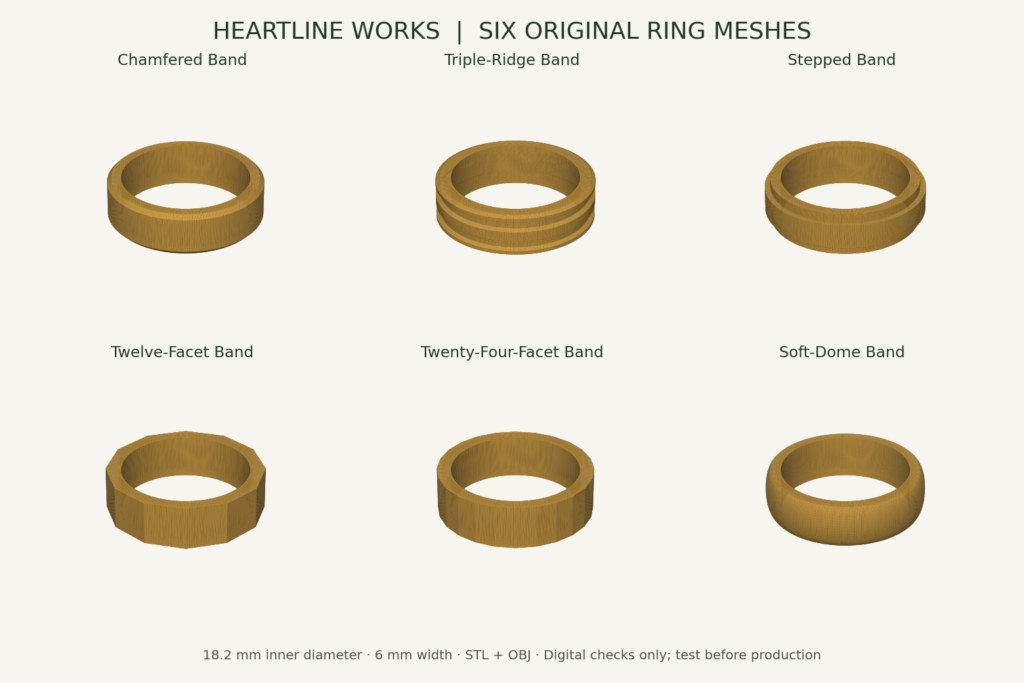
Download six original ring STL files with matching OBJ meshes. This sample pack lets you compare chamfered, ridged, stepped, faceted and domed band geometry using documented dimensions and digital mesh checks.
Heartline Works original designs · Version 1.0 · October 26, 2026
Download all 6 ring designs — ZIP, approximately 945 KiB
Extract the ZIP on your computer before opening a model. Each design is supplied as a binary STL and a matching OBJ. The archive also contains a preview of the actual meshes, a README, validation results and the generation source. It does not contain editable Rhino 3DM files.
What is included in the ring STL pack?
| Original design | Profile | Maximum outside span | Mesh volume |
|---|---|---|---|
| Chamfered Band | Flat outer face with bevelled outer edges | 22.2 mm | 736.81 mm³ |
| Triple-Ridge Band | Three raised circumferential ridges | 22.6 mm | 733.60 mm³ |
| Stepped Band | Raised central section with lower shoulders | 22.8 mm | 744.94 mm³ |
| Twelve-Facet Band | 12 flat outer faces with a circular bore | 22.6 mm | 737.61 mm³ |
| Twenty-Four-Facet Band | 24 flat outer faces with a circular bore | 22.2 mm | 735.21 mm³ |
| Soft-Dome Band | Curved outer profile with a straight inside wall | 22.6 mm | 764.26 mm³ |
The faceted models’ outside spans are corner-to-corner measurements, not across-flats measurements. Volumes are calculated from the supplied triangle meshes and rounded here; the archive’s validation file gives more digits. The two faceted bands intentionally have different outside diameters as well as different facet counts.
Check dimensions before choosing a ring size
Interpret the models’ numeric coordinates as millimetres. A nominal inside diameter of 18.2 mm is a dimensional specification, not a certified US, UK or EU size label. Import a file, measure the bore and confirm the 6 mm band width before slicing. Polygon meshes approximate curves, so small differences can appear between a nominal circle and a measurement across a mesh chord.
These models are intentionally supplied at one common bore and width so their profiles can be compared. They are not a complete ring-size collection. If you scale uniformly, the bore, width and wall thickness all change together. For example, multiplying the geometry by 1.05 changes a nominal 18.2 mm bore to 19.11 mm and a 6 mm width to 6.3 mm. If only the bore should change, use a suitable modelling workflow and recheck the whole model.
Digital file checks and their limits
- Each source mesh has one connected component.
- Every undirected mesh edge has exactly two incident triangles.
- Neighbouring triangles have consistent shared-edge orientation.
- No zero-area triangles were found, and signed mesh volume is positive.
- The exported binary STL was read back and compared with the source triangle coordinates.
- The ZIP archive passed an integrity check; checksums for model files are included.
No physical print, support trial, casting or wear test has been performed. These checks describe the digital files; they do not certify a resin, machine profile, finished fit or manufacturing process. The models have no supports, sprues or shrinkage allowance. Check the imported mesh in your own software before spending material or metal.
How to use the ring models
- Download and extract the archive, then read README.txt.
- Choose one STL or OBJ and confirm its dimensions after import. They are alternative formats for the same design, not two parts to combine.
- Select a material and workflow appropriate to a visual prototype or a casting pattern. Follow the manufacturer’s preparation and handling instructions.
- Add orientation, supports and any process-specific preparation in suitable software.
- Make one test piece and measure it before proceeding with a production batch.
For an initial mass estimate, enter the mesh volume into the casting weight calculator. Select the intended alloy and remember that supports, feed systems and finishing require separate consideration. Read the casting weight guide for the method and limitations.
Original design source and licence
These models were constructed for Heartline Works from mathematical profiles. They do not use competitor models, traced artwork or third-party fonts. They use the Heartline Works Original Design licence: free for personal projects and for physical products you make and sell. Do not resell, share or redistribute the digital files themselves, alone or in a pack.
See the source and licensing policy and file review process. To understand what an editable source file would add, read STL vs 3DM for jewelry. Browse the jewelry and casting collection for other designs with their own dimensions and listed formats.
Frequently asked questions
Do I upload the ZIP to my slicer?
Extract it first and open one model file. Keep the README and validation record with your workshop copy.
Are the files ready for every casting process?
No. Ask your printer or casting provider to review the model, material and preparation requirements. Digital mesh checks are not a substitute for that review.